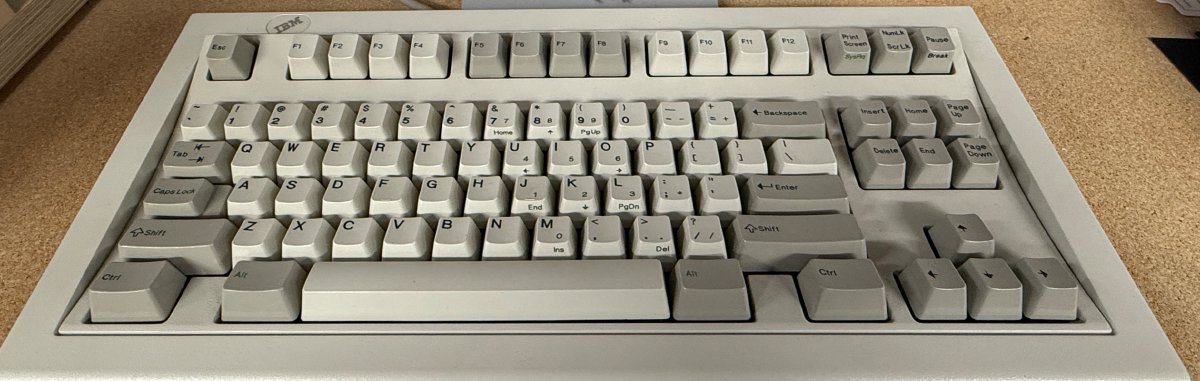
The buckling spring is the mechanism behind the most distinctive sound in computing history — the loud, unapologetically mechanical click-clack of an IBM keyboard. Touch one once and you’ll never mistake it for anything else.
How It Works
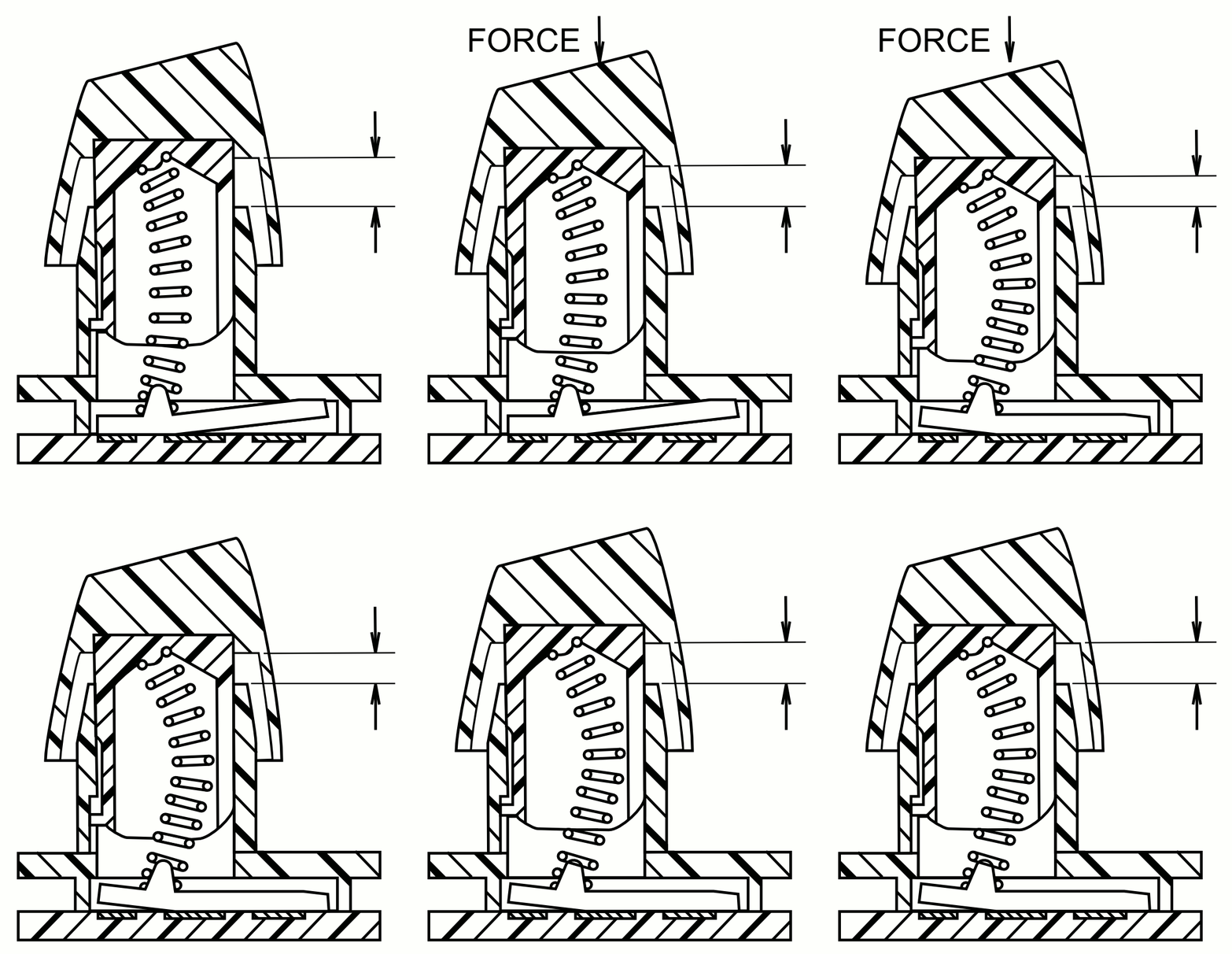
Each key sits above a small coiled spring held vertically inside a plastic barrel. The mechanism does three things at once, all mechanically linked:
- As your finger pushes down, the spring compresses linearly.
- At a precise force threshold — well before the key bottoms out — the spring suddenly buckles sideways instead of compressing further. That lateral collapse is what you hear and feel as the “click.”
- The buckling motion pivots a small plastic hammer at the base of the barrel. The hammer either closes a membrane contact (Model M) or shifts a capacitive pad (Model F) to register the keypress.
The genius of the design is that the click and the registration happen at the same instant. On most “clicky” switches the click is decorative — it fires somewhere in the travel and isn’t mechanically tied to actuation. On a buckling spring the snap is the actuation. Your finger feels the key register at exactly the moment it sounds.
The “click-clack” you hear is actually two events. The sharp click is the spring buckling. The duller clack that follows a fraction of a second later is the keycap reaching the bottom of its travel.
Model F and Model M
Two generations carry the buckling spring lineage.
The Model F, introduced in 1981 with the IBM 5150 PC, used capacitive sensing. It went on to ship with the PC/XT, the AT, and the 5155 portable. Heavy steel backplate, dense construction, expensive to build — and brutally durable. A working Model F that arrives in your shop today is more than 40 years old, and the only thing usually wrong with it is that the foam underneath the spring mat has dried out.
The Model M arrived in 1985 with the IBM PS/2 and replaced capacitive sensing with a membrane underneath the hammers. Cheaper to manufacture, slightly lighter, but mechanically the same buckling-spring action. The Model M is the keyboard most people think of when they hear “IBM keyboard” — the 101-key Enhanced layout it shipped with became the de facto standard for everything that came after.
Production didn’t end with IBM. Lexmark took over Model M manufacturing in 1991 when they spun out from IBM, then sold the tooling to Unicomp in 1996. Unicomp still ships brand-new buckling spring keyboards from the original IBM/Lexmark plant in Lexington, Kentucky. Forty-plus years after the design first appeared, you can still walk in and buy one new.
The Space Saving Keyboard (SSK)
The keyboard at the top of this page is the IBM Space Saving Keyboard — the SSK — the rarest member of the buckling spring family and one of the most coveted in the collector market today. It’s an 84-key Model M with the numeric keypad and the gap between the main and arrow blocks removed. What we now call a “tenkeyless” or “TKL” layout is a category the SSK essentially invented.
IBM announced the SSK in September 1986 for the IBM 3162 ASCII Display Station, then sold variants through 1999 under part numbers including the original 1391472 and later 1392934 / 1397685 revisions. The navigation cluster (Insert/Home/PgUp, Delete/End/PgDn, and the arrows) doubles as a software-toggled numpad via NumLock — small printed legends on those keys map them to 7/8/9/4/5/6/1/2/3 — so you can still touch-type numbers when you need to.
Why it’s rare: production volumes were a fraction of the full-size 101-key Model M. The SSK was aimed at industrial terminals and tight-desk environments and never had the broad office footprint of its bigger sibling. Lexmark continued producing them through the 1990s, but never in the quantities of the standard Model M.
In the modern mechanical keyboard community, every tenkeyless layout shipping today traces directly back to the SSK. Working originals routinely sell for several hundred dollars on the resale market, and Unicomp now ships a modern remake — the “New Model M SSK” — from the same Lexington plant that built the originals.
Why It's Still Loved
A buckling spring is the loudest mainstream keyboard switch ever shipped. That’s a bug for some people and a feature for others. For typists who came up on these keyboards in the 80s and 90s, the audible feedback isn’t noise — it’s confirmation. You know when a key registered because you heard and felt it.
The mechanism also ages gracefully in a way most keyswitches don’t. There are no rubber domes to harden, no MX-style springs to weaken, no contacts to oxidize past recovery. A 40-year-old Model F or M will, after a thorough cleaning, type exactly like it did when it left the factory. That’s a rare quality in vintage hardware.